
Founders Perspective
Is the Message of Gold’s Meteoric Rise Concerning?
John Merrill, January 29, 2026
It is a great feeling to own an asset when its price surges. Gold may at least partially be an exception. Most everyone knows that gold serves as a disaster hedge…or a severe inflation hedge…so does gold’s explosive gains signal something we should be concerned about?
While anything is possible, gold’s rise today is troubling primarily in the context of geopolitical rivalries.
America has been the dominant power in the post-cold war period. Much of that power is economic in that we are the largest economy and hold the primary reserve currency, the Dollar. This gives us enormous leverage in international trade as almost 80% of all cross-border transactions are priced in Dollars (even when the U.S. is not on either side of the trade.)
International trade in Dollars is conducted via the Society for Worldwide Interbank Financial Telecommunication (SWIFT) system. The willingness of America to provide liquidity to this system is of immeasurable importance to the world. Cutting off countries from SWIFT – as the West did with Russia after it invaded Ukraine – is an enormous handicap to their ability to trade.
China has long thought that this system gave the U.S. too much power (even to sanction China itself in a trade battle.) Their financial system lacks the depth and openness required, and the yuan remains too tightly controlled by the state to serve as a significant reserve currency. Yet they want another option to conduct trade rather than relying on the SWIFT system.
Enter gold, already the second biggest reserve “currency” behind the Dollar. In the last two years, China has become the world’s marginal buyer of gold according to Bloomberg. David Kotok of Cumberland Advisors points out that the Chinese have set up an alternate to the SWIFT system known as CIPS. CIPS issues tradeable warrants backed up by China’s growing hoard of gold.
Use of the CIPS system is growing fast and is now used in 30 countries. Its only limitation is the amount of gold in its vaults. That is why China keeps buying. The big price gains also increases their CIPS capacity. In other words, they are not price sensitive. As shown on the chart below, both the price of gold in Yuan and the number of warrants issued have gone ballistic.
This allows China to influence and control more international trade which provides more security for them. It also supports Dollar weakening which has been occurring for over a year. U.S. protectionism (tariffs) accelerates the process.
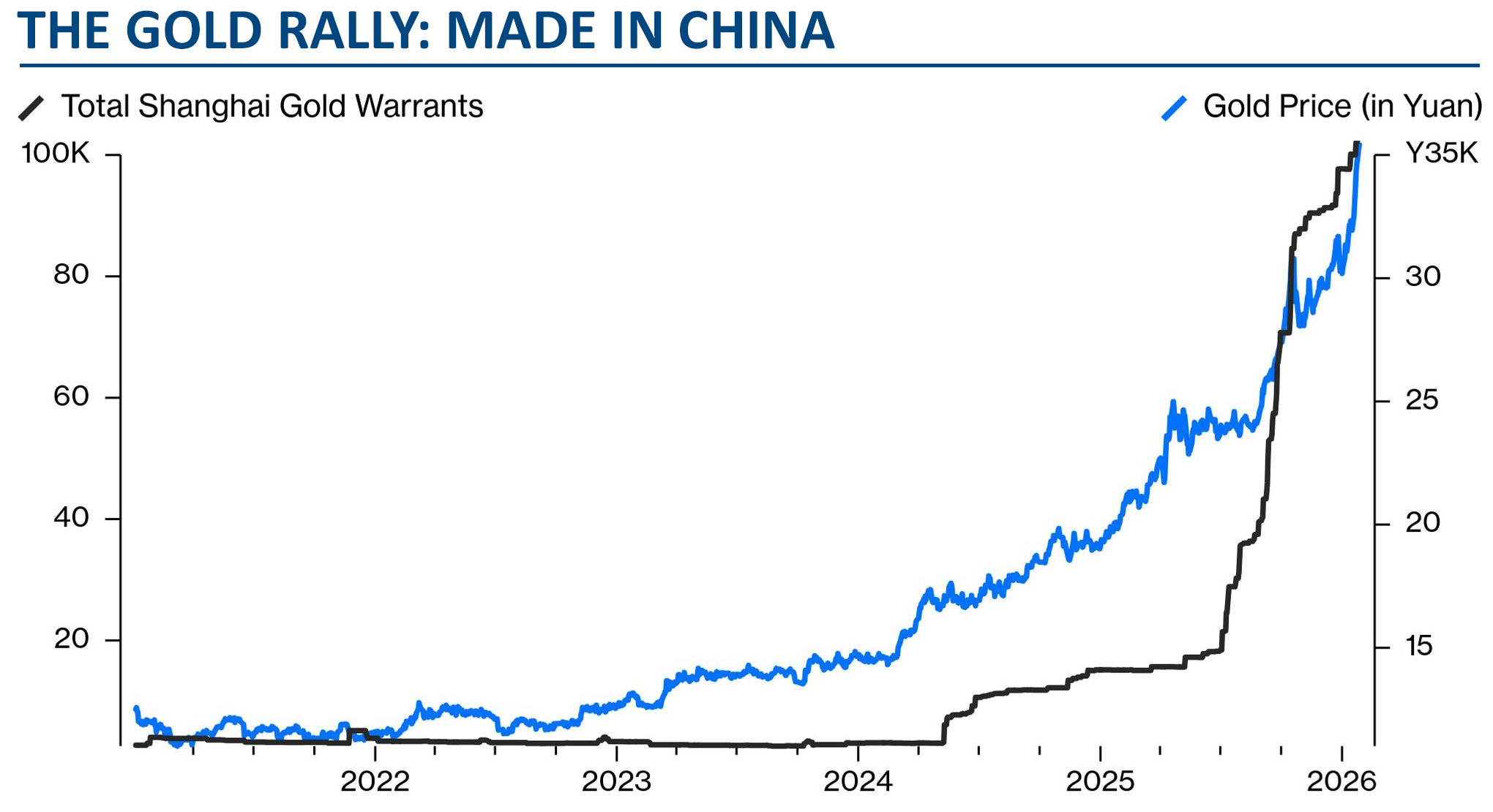
Source: Cumberland Advisors, Bloomberg
Gold is not the only asset impacted by this rivalry of great powers and the systems that support them. The recent trade negotiations with China showed that they also have leverage over the U.S. and the rest of the world with rare earth mining and refining. This has led to an all-out campaign by America and others to increase our supply and refining capabilities.
This sudden change from efficient, just-in-time supply chains toward self-sufficiency and security has also impacted the price of semi-precious metals like silver, platinum, and palladium where year-on-year price gains have greatly exceeded that of gold.
Base or industrial metals such as copper, nickel, and aluminum have also experienced huge price gains over this period. These are fundamentally important materials for domestic manufacturing -- in peacetime but more importantly in any war or threat of war.
In summary, the massive gain in the price of gold appears to be part of a larger story of a new global order where each side believes it must provide self-sufficiency for its own security. China led the world down this path with its 2015 plan that called for Chinese dominance and/or self-sufficiency by 2025 in the 10 major areas it believes critical. Much of this has already been achieved. This accompanied a massive military buildup.
Gold is a major part of China’s plan. Higher prices for the reserve currency metal are a plus, not a minus, as it builds its reserves faster and with less capital actually spent. That does not mean they will not from time to time pull back their buying, but the price will likely remain on an upward path so long as this plan continues in place. Ed Yardeni last year’s appreciation dinner speaker, has forecasted (since 2023) that gold will reach $10,000/oz by the end of 2029.